



A key role in sewer lining success
Deep cleaning is necessary before replacing the lining of sewer pipes. High-powered nozzles and chain cutters make pipe cleaning quick and efficient.
Pipe lining has become a go-to solution for renewing ageing sewer and storm lines without the disruption of open-cut excavation. By installing a new liner inside an existing sewer pipe, crews can restore structural integrity, seal leaks and extend service life while keeping streets, pavements and landscapes largely untouched.
But the success of that liner depends on what happens first. Liners are installed by inverting or pulling them into the host sewer pipe and holding them tightly against the pipe wall with air or water pressure, while steam or hot water is used to cure the resin and form a new structural pipe within the existing one.
However, blockages in the sewer pipe formed by tree roots, hardened mineral scale, grease buildup, silt and debris can interfere with this process. If a liner is installed over these obstructions, it cannot fully contact the host pipe, which can lead to wrinkles, voids, weak spots or areas where the liner never properly bonds or cures. Over time, those defects can become failure points.
That is why pipe cleaning is not just a preliminary step — it directly affects the integrity of the finished liner. Fortunately, the right combination of nozzles and cutters allows crews to remove even the most stubborn buildup, allowing the liner to work properly once it is installed.
“The inside of the sewer pipe must be spotless for the liner to work properly,” explains Dan Story, an experienced trainer and Operations Manager at KEG Technologies, a leading manufacturer of nozzles and chain cutters used to clean sewer and stormwater lines. “In industry terms, this condition is described as ‘gun barrel clean.’ Just as a firearm barrel must be meticulously cleaned to function reliably, the pipe interior must meet the same standard to ensure proper liner adhesion and long-term performance.”
Common lining techniques
Over the past several decades, contractors have adopted a variety of lining technologies, each suited to different pipe conditions, diameters and access constraints.
Cured-in-place pipe lining, known as CIPP, is the most widely used method for sewer rehabilitation. In this approach, a flexible liner saturated with a thermosetting resin is inserted into the host pipe.
Once positioned, internal pressure forces the liner tightly against the pipe wall, and the resin is cured to form a rigid, continuous pipe. Because the liner relies on chemical curing, surface condition plays a direct role in performance.
Fibreglass-reinforced liners are a variation of CIPP designed for applications where higher stiffness and load-bearing capacity are required, including stormwater and drainage systems. These liners incorporate glass fibre reinforcement within the resin system, resulting in a finished pipe with greater structural integrity.
From a chemical standpoint, the curing performance of lining materials such as fibreglass resin can be compromised by factors including dirt, debris, roots or grease residue within the pipe, as well as an incorrect resin-to-chemical mixture.
A dirty pipe doesn’t just block physical contact. It can also interfere with the resin’s chemistry. When resin mixes with various residues in the pipe, it may not ‘wet out’ properly, meaning it can’t work the way it’s designed to. In those areas, the resin can cure weakly, unevenly or not at all.
Chemical-related liner failures usually present as one of several symptoms. The liner may remain tacky or soft, deform under normal flow conditions, crack prematurely, shrink away from the host pipe or develop blisters or bubbles caused by gases trapped during curing.
Spiral-wound lining systems use a different approach, relying on mechanical assembly rather than resin curing. In these systems, a continuous PVC profile is fed into the pipe and spirally wound to form a new liner inside the existing pipe. The liner is installed at a reduced diameter and then mechanically expanded until it presses against the interior wall.
Because the liner is formed mechanically, this method is generally more tolerant of minor surface irregularities, although significant protrusions or obstructions still need to be removed to allow proper expansion and alignment.
Nozzles and chain cutters
According to Story, when relining failures occur they can typically be traced to one of two causes: debris that remained in the pipe at the time of installation or improper curing of the lining material.
To clean a sewer line thoroughly prior to lining, specialised jetting nozzles are operated in conjunction with a vacuum truck. The process combines high-pressure water and continuous debris removal to restore the pipe interior to a condition suitable for liner installation.
High-pressure water from the truck is delivered through a hose to the nozzle inside the pipe. The nozzle directs multiple water jets outward and backward. The rear-facing jets provide thrust, pulling the nozzle through the line, while the forward and radial jets scour the pipe wall. This action loosens grease, scale, sediment, roots and other deposits adhered to the interior surface.
As the nozzle advances, dislodged material is flushed downstream toward the access point. The vacuum truck simultaneously removes this slurry of water and debris.
When properly executed, this jetting-and-vacuum process leaves the pipe interior uniformly clean, free of loose material and ready for inspection and lining.
However, the level of cleaning is only as good as the nozzle at the end of the hose, says Story. There are tiers of nozzles rated for water efficiency from Tier 1 (about 30% efficient), Tier 2 (50-60% efficient), to Tier 3 (75-98% efficient). In the case of KEG’s Tier 3 nozzles, the high-performance fluid mechanics design leaves little room for power losses and excessive turbulence.
“In many cases, using a high efficiency Tier-3 nozzle will provide significantly more cleaning force, at a greater distance, with less water,” says Story.
When the objective is to aggressively scour the pipe wall prior to installing a liner, Story says a controlled-rotation nozzle is typically the most effective option. “Controlled rotation refers to intentionally slowing the rotation and spin of the nozzle head or body. By reducing rotational speed, the nozzle maintains contact with the pipe surface for a longer duration, which increases cleaning effectiveness.”
KEG’s controlled-speed rotational nozzle, the Aqua Power 700, is designed for general pipeline cleaning and grease removal applications. By consistently running at 650rpm, cleaning is faster and more efficient because of the consistent contact with the jets.
Although the skilful use of high-powered or controlled nozzles can sometimes dislodge partial obstructions in smaller pipes, tree root intrusions must be completely removed to avoid compromising relining operations. Resolving the worst cases in large sewer pipes requires the use of special heavy-duty chain cutters that can remove even a ‘wall of roots’.
For the toughest blockages, KEG’s chain cutter nozzles utilise the power of high-efficiency nozzle water pressure to provide sufficient torque to cut through a thick root mass. When high-pressure water enters the chain cutter nozzle chamber, it is directed to spin the cutting chains at high velocity with enough torque to avoid seizing.
In sewer pipe lining, success is decided long before the liner ever enters the pipe. No matter how advanced the lining system is, it cannot overcome a sewer pipe that is coated in roots, grease, scale or debris. High-performance nozzles, controlled rotation and heavy-duty chain cutters make lining work possible.
“When crews leave a pipe truly ‘gun-barrel clean,’ they are creating the conditions that will allow the liner to cure, bond, expand, and perform exactly the way it was engineered,” says Story.
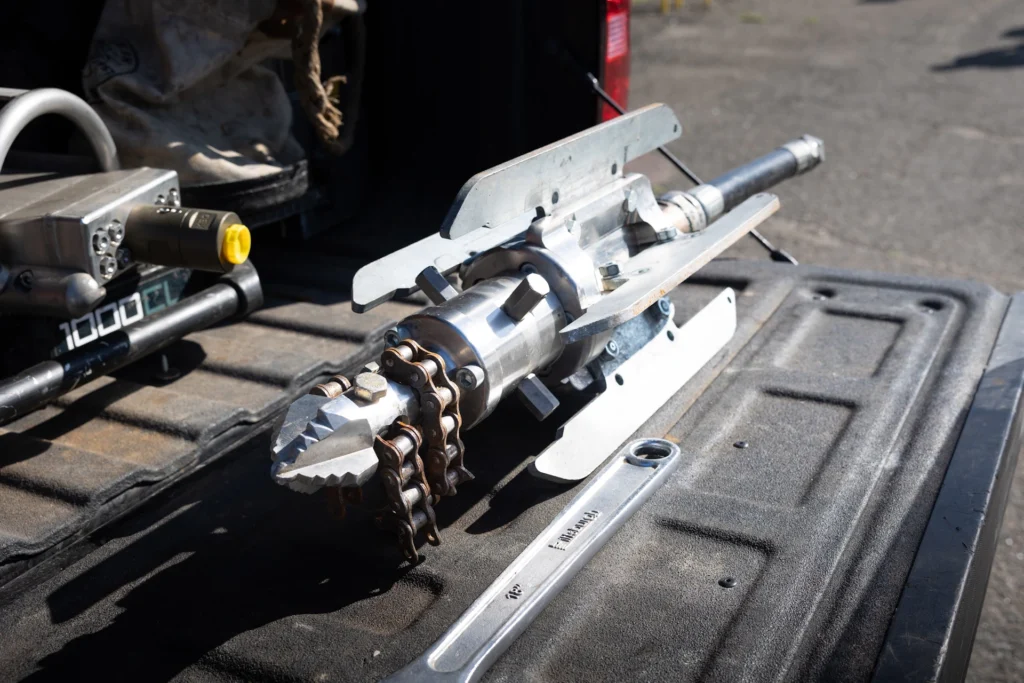
KEG Technologies Chain Cutter nozzle
More articles like this can be found in the latest issue of Protective Coatings Expert