


Offshore drone inspection flying high
CAN-USA and Shell are redefining offshore inspections with the Elios 3 UT drone
The Elios 3 UT drone with its tether power unit is deployed on offshore Shell platforms and operated by expert CAN-USA pilots to perform safer and more efficient offshore inspections.
“Once a manual operation, drones are providing a safer, more time-efficient option to inspect offshore platforms, helping keep the lights on at home,” says Shell USA.
Offshore platforms and FPSOs present some of the most challenging environments to inspect. Tanks, piping and lifting equipment all require regular monitoring, while the risks of corrosion and dropped objects demand constant vigilance. Traditionally, rope access has been the backbone of these inspections, with skilled technicians completing much of the critical work. While effective, rope access can be time-consuming and exposes teams to challenging conditions. Looking for a way to enhance safety and efficiency without losing the expertise of its technicians, inspection, maintenance and repair company CAN-USA turned to drone inspection with the Elios 3 UT.
Offshore inspection challenges
Offshore oil rig and FPSO operators need to maintain asset integrity while minimising downtime and risk. Inspections of tanks, cranes, and piping often take significant time using rope access, and some areas remain difficult to reach. Dropped object inspections are particularly demanding, as early detection of corrosion-related hazards can be difficult with limited access. Shell and other operators rely on CAN-USA for inspecting many of these critical assets. Driven by their spirit of innovation, CAN-USA looked at drone inspection to improve coverage and efficiency of their inspections while ensuring the safety of their team. Drone inspection can collect video recordings, thermal imaging, 3D models, ultrasonic thickness measurements (UTM) and gas levels. One of the biggest benefits of drone data is the ability to localise within the 3D model any points of interest and the collected UT measurements, which provides better situational awareness for the inspectors. Inspection drones also have the ability to fly tethered for prolonged flight time or untethered to inspect hard-to-reach areas where the tether cable can’t reach.
From ropes to drone inspection
Richard Turner, Specialty Services Manager and Head of the Drone & Robotics Program at CAN-USA proposed a practical solution: train rope access technicians to operate drones. These technicians already knew what to look for on offshore platforms and FPSOs, and with drones in hand they could extend their reach and efficiency without depending on external drone pilots unfamiliar with offshore environments. This approach kept inspections in the hands of experts while unlocking the benefits of drone technology.
“Rope access technicians are retraining to use new cutting-edge drone inspection technology on Shell-operated offshore platforms,” says Shell USA.
A great example of this is Tori Gibson, who has worked in the oil and gas industry for over nine years. She spent four of those years conducting manual rope access inspections, but more recently has transitioned to conducting offshore platform drone inspections. “Not only are drones safer, but they are also time efficient,” says Shell USA. “Previous rope access inspections could have taken an entire day, and now inspections can be accomplished in minutes. In some instances, because they allow easier remote access, drone inspections alleviate the need to stop production on the platform.”
The Elios 3 UT drone became central to this strategy. It is now used for tank and vessel inspections, piping surveys, lifting equipment assessments and preventing dropped objects. By supplementing rope access with drone technology, CAN-USA has reduced time spent in hazardous areas while achieving greater coverage. The Elios 3 UT’s LiDAR maps, localised points of interest and onboard UTM payload provide a richer picture of asset health, while the Inspector software makes reporting more straightforward for operators.
“The Elios 3 gives us an unparalleled ability to perform confined space inspections safer and more efficiently than ever before,” says Turner. “That efficiency is further boosted in the hands of a qualified and competent inspector.”
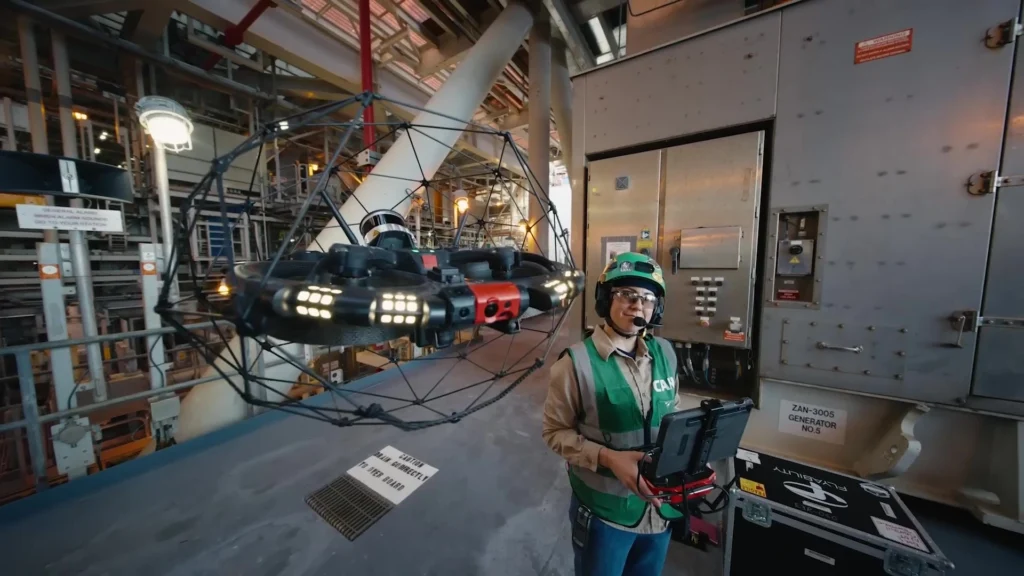
Tori Gibson has transitioned to conducting offshore platform inspections with drones
Adoption results
The adoption of drone inspection has brought measurable benefits. CAN-USA’s offshore teams can complete inspections faster and with fewer interruptions to operations, while rope access is reserved for areas that truly require human intervention. On Shell offshore units, this hybrid approach has led to more complete inspections, greater situational awareness and safer workflows for technicians.
A major enabler has been the Elios 3 tether power unit. With a continuous power supply, CAN-USA can now sustain long missions without pausing for battery swaps, allowing entire tanks or cranes to be inspected in a single deployment. The tether also provides assurance when flying over open water, ensuring the drone can be recovered even in the event of failure. By eliminating the need to carry lithium batteries into hazardous offshore environments, it further strengthens operational safety.
“The tether has opened up areas we would have never been comfortable operating the Elios 3. We expected the longer flight times, but we gained so much more,” says Turner.
By combining the proven expertise of rope access technicians with the advanced capabilities of offshore drones, CAN-USA has created a balanced, efficient inspection strategy. The Elios 3 UT and its tether power unit have allowed the company to deliver safer, faster and more complete inspections on offshore platforms and FPSOs. This forward-looking approach, driven by Turner’s vision, is reshaping offshore drone inspections and setting a new benchmark for the industry.
Check out more articles like this in the latest issue of Protective Coatings Expert