



A glass-fused-to-steel effluent tank in Buckinghamshire and a pasteuriser tank in Suffolk, UK were experiencing significant leakage due to corrosion. Temporary patch repairs had been attempted previously in both cases, but the clients required a long-term industrial tank lining solution that would ensure full containment and protect the structures against further degradation.
Corroless Eastern has extensive experience working with glass-fused-to-steel (GFtS) tank lining, supported by dedicated research into how these tank systems respond to coating technologies.
Glass-fused-to-steel and bolted/sectional tanks have been used extensively in the water, wastewater and biogas industries because of their cost effectiveness and speed of erection when compared with other tanks. Most commonly, the steel panels are protected using glass enamel, epoxy or galvanizing. All these treatments have a finite lifespan, which is reached when the surface protection leads to corrosion and in aggressive environments, perforations.
In terms of preparation these tanks are very similar to steel tanks; however, there are some intricacies that must be taken to into account.
Glass-fused-to-steel tanks are a challenging tank lining application with complexities that many others overlook, and an area that Corroless Eastern has researched extensively.
Glass-fused-to-steel is marketed as an extremely durable solution; however whilst the finished surface offers good chemical resistance, this does not tell the full story.
Once the thin enamel surface layer is broken through mechanical damage, moisture and aggressive chemicals are absorbed into the inherently porous substrate. The presence of moisture against the steel creates a corrosion cell, which if accelerated by aggressive agents such as biogenic sulfuric acid, rapidly leads to perforation.
The glass-fused-to-steel Buckinghamshire solution
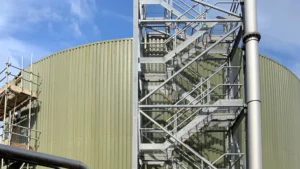
The effluent tank in Buckinghamshire required long-term protection
Following inspection, Corroless Eastern proposed two options to the client, who selected the more durable polyurea tank lining system ̶ SPI Corrolastic UB. This system offers exceptional durability for wastewater and effluent tank lining applications.
The first step was the removal of the polyurethane pointing applied during original tank construction. This step is essential to:
- Expose corroded or at-risk areas where breakdown often occurs beneath the sealant;
- Eliminate complex edges and voids that would prevent a seamless coating application.
Specialist Japanese leather knives were used for this process.
Cleaning & soluble salt removal
All surfaces were steam-cleaned with an emulsifying degreaser to remove fats, greases and soluble contaminants. Effective soluble salt removal is critical, as remaining salts can lead to osmotic blistering beneath the tank lining.
“Soluble salt tests were carried out as part of our standard QA procedures,” says Oliver Hunt, Company Director, Corroless Eastern, UK.
Surface preparation
Adjacent panels not being coated were temporarily protected with rubber sheeting.
The glass enamel was sweep-blasted to expose clean, fresh surfaces, and all exposed steel was prepared to SA 2.5 abrasive blasting standards in accordance with ISO 8501-1.
Surface roughness was recorded using a profile needle gauge and all surfaces were vacuumed clean, and dust tape tests completed to confirm the effectiveness of the preparation.
Climatic conditions were monitored and recorded before and during the coating application.
Priming & profiling
The prepared surfaces were primed using Corroless Eastern’s specialist Corrolast DSP primer, designed for superior adhesion to glass enamel and steel substrates while providing enhanced anti-corrosive protection.
A quartz broadcast mechanical profile was applied into the wet primer to create an optimal bonding surface for the spray-applied polyurea lining.
Perforated sections of the tank were bridged using galvanized steel plates bonded with a thixotropic epoxy adhesive.
Polyurea application
Areas not to be coated were masked using specialist cutting tapes, suitable for the rapid gel time of polyurea systems.
Corroless Eastern’s trailer-mounted unit was mobilised to site, and SPI Corrolastic UB was spray-applied to a nominal thickness of 2mm across all prepared surfaces.
Thickness checks were carried out, and any areas below the required build were immediately rectified ̶ a key advantage of rapid-cure polyurea systems.
Quality assurance & final protection
The cured lining was tested using a DC holiday spark tester to identify and address any pinholes, ensuring full continuity of protection ̶ crucial for tank corrosion repair in aggressive wastewater environments.
All termination points were then sealed using a chemical-resistant polyurethane sealant to ensure a fully encapsulated and durable finish.
The glass-fused-to-steel Suffolk pasteuriser tank solution
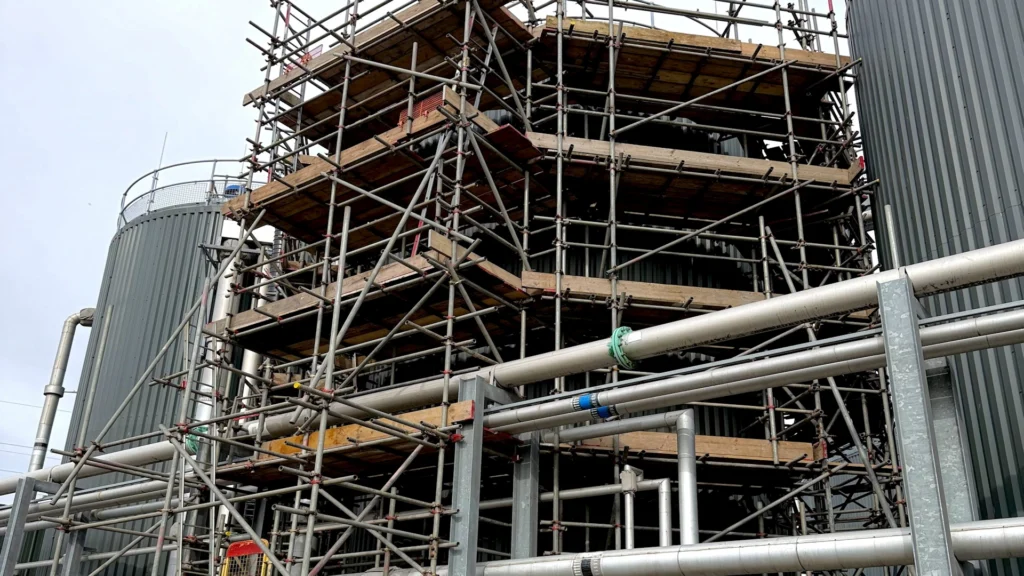
The glass-fused-to-steel pasteuriser tank in Suffolk required a long-term industrial tank lining solution that would ensure full containment and protect the structures against further degradation
This glass-fused-to-steel pasteuriser had been found to be leaking gas into the surrounding environment. Following drain down and internal inspection, the tank was found to be suffering from widespread corrosion, with localised erosion in specific areas caused by the action of the spray bars on the glass enamel surface.
These areas of erosion and perforation had been patched by others using stainless steel plates, but the corrosion across the wider vessel was too extensive for localised repairs to offer a long-term solution. A full industrial tank lining was required.
“Given the aggressive nature of the environment ̶ hydrogen sulfide and biogenic sulfuric acid at elevated operating temperatures ̶ we put forward a choice of chemical-resistant tank lining options suited to the conditions,” says Hunt. The client selected the most durable specification available, reflecting the criticality of the asset: a spray-applied elastomeric tank lining in the form of PPG Aquataflex 506, applied to a nominal thickness of 2mm.
Cleaning & soluble salt removal
Following clean-down by others, the tank internals were washed using potable water and pressure-washing equipment to remove soluble salts, which are almost invariably present in tanks of this type. This stage also revealed the true extent of the corrosion present across the vessel.
Soluble salt levels were then tested and recorded in line with best practice for industrial tank lining work. This is a critical step: residual soluble salts beneath a tank lining draw moisture through the coating, generating fluid-filled osmotic blisters that cause premature lining failure. The risk is compounded in tanks operating at elevated temperatures, where the driving force for moisture migration is significantly higher.
Surface preparation
Once cleaning operations met the required standard, the tank internals were prepared using abrasive blasting. Exposed steel was taken to Sa 2.5 in accordance with ISO 8501-1. Where the glass enamel remained intact, it was sweep-blasted to provide a clean, profiled surface for the new glass-fused-to-steel tank lining to bond to. Blast pressure was reduced during work on the glass-fused steel areas to prevent excessive shattering of the enamel.
All blasted surfaces were vacuumed clean prior to coating to ensure optimum adhesion. Temporary dehumidification and heating were installed to maintain the correct climatic conditions for coating application ̶ temperature, dew point and relative humidity were tested and recorded throughout as part of Corroless Eastern’s standard quality assurance process on all tank lining contracts.
Application
All surfaces were primed using Corrolast DSP, a primer specifically developed and tested for adhesion to glass-fused-to-steel tanks. Quartz aggregate was broadcast into the wet primer to create a mechanical profile for the tank lining to key into.
In the areas where stainless steel repair plates had previously been fitted, epoxy adhesive fixings were bonded in position to receive stainless steel wear plates following tank lining application. In abrasion-prone zones such as these, additional mechanical protection was considered essential to maximise the long-term performance of the corrosion-resistant lining.
PPG Aquataflex 506 was then spray-applied to a nominal thickness of 2mm across all areas. This is a 100% solids epoxy/polyurethane/polyurea hybrid tank lining system designed for fast cure and high chemical resistance ̶ well suited to environments containing acids and sulfides at process temperatures.
Testing
Due to the short overcoat window of this material, DC holiday spark testing was conducted within the same shift so that any pinholes identified could be made good within the recoat window. “In chemically aggressive environments such as this, a single pinhole represents a direct path to the substrate and a point of lining failure ̶ making this a non-negotiable step in our tank lining quality assurance process,” explains Hunt.
The stainless steel wear plates were then fixed to the previously-bonded anchors in the spray bar zones, providing enhanced abrasion resistance in the areas of highest mechanical wear.
Finally, all termination points and edges were sealed using a chemical-resistant jointing compound to prevent any ingress at the lining perimeters.
Check out more articles like this in the latest issue of Protective Coatings Expert