


Beneath the Surface: Gareth Hinds talks to Protective Coatings Expert
Gareth is Senior NPL Fellow in the Electrochemistry Group at the UK’s National Physical Laboratory (NPL). His primary expertise is in the development of novel in-situ diagnostic techniques and standard test methods for assessment of corrosion and material degradation in energy applications. He is a Fellow of the Royal Academy of Engineering and holds Visiting Professorships at University College London, the University of Strathclyde, Harbin Institute of Technology and the Institute of Corrosion Science & Technology, Guangzhou. He is the author of over 200 publications and is currently President of the European Federation of Corrosion (EFC) and Past President of both the World Corrosion Organization and the Institute of Corrosion.
Q, I see you’ve finished your tenure as the President of the World Corrosion Organization. Did that actually come to an end, or was that a decision you made not to be president anymore?
Gareth Hinds. I had served my three-year term, so in 2025 I stepped down just in time to take over the EFC Presidency, which will run until the end of this year.
Q, When you took over the Presidency of the EFC, did you have any plans to move things forward in any particular direction?
Gareth Hinds. I had three main priorities in my Presidency. The first one was to maintain EUROCORR as the flagship conference of the EFC. It’s what the EFC is most known for. It’s an annual conference that takes place in a different European city every year. It’s bid for by member societies three years in advance, and it’s going to be in Dublin – my hometown – this year.
The second priority was to increase the financial sustainability of the Federation, because we are heavily reliant on the EUROCORR conference. It’s by far the biggest source of income for the EFC.
To do that, there’s obviously two aspects of increasing financial sustainability. The first one is to explore other sources of revenue. We have a Chief Operating Officer, Pascal Collet, and we’re supporting him in opening new revenue streams, mainly in organising other conferences, like the PractiCORR conference, which took place last year and focuses on the more practical aspects of corrosion.
We are also hosting a series of webinars on hot topics. We had one on AI last year and this year’s one, held on May 12th, was on corrosion in defence systems.
At the same time, we are reducing the costs of our administration. The EFC was established in 1955 with founder member societies from the UK, France and Germany. And it’s had three secretariats ever since, offices in London, Frankfurt and Paris. So, we’re now consolidating that into one office in Paris. The Frankfurt office ceased to exist at the end of last year and the London one will cease to exist at the end of this year.
Everything will be in Paris, which will save us quite a lot of money, simplify the administration and give the members a single point of contact. So, I think that’s all positive.
Then my third priority, and probably the most important one, is to increase the sense of community amongst the EFC. And that is really important, particularly as the EFC grows.
It’s got an increasingly global presence. And the bigger it gets, the more important it is to hold on to that ethos, which it’s had since the start. It’s a way of bringing people together, of sharing knowledge, sharing experience, supporting each other and being a greater collective voice than we can be individually. To do that, we’ve established in-person get-togethers of Member Societies and Affiliate Members at every EUROCORR conference.
As a new Affiliate Member, Protective Coatings Expert has been invited to the next meeting.
As well as the in-person meetings at EUROCORR, we have two online meetings during the year. And then we will be meeting again in-person in Dublin.
I find these meetings very beneficial because they just give a bit of a social touchpoint and an opportunity to discuss things that we don’t have time to discuss at the annual General Assembly. The General Assembly takes place in June, and it’s only two hours long. There’s a lot of things to vote on and it’s very formal. There’s not much opportunity to have discussions about various issues or share information. So, I think these three other meetings that are more informal and discussion-based and where there’s no rigid agenda, are quite helpful and do help to build that community.
Of course, I’ve had one-to-one conversations with all the Member Society representatives to hear what their thoughts are – to see what they want from the EFC – if there’s anything more we can do. But I think it’s great having these regular, particularly in-person touchpoints where we can share experiences, learn from each other, plan different initiatives and just share information on what events are going on, and make people more aware of the benefits of being in this Federation.
So those were my three main priorities and I’m quite happy with how the progress is going on all three of them.
Read more of this interview with Gareth Hinds in the latest issue of Protective Coatings Expert
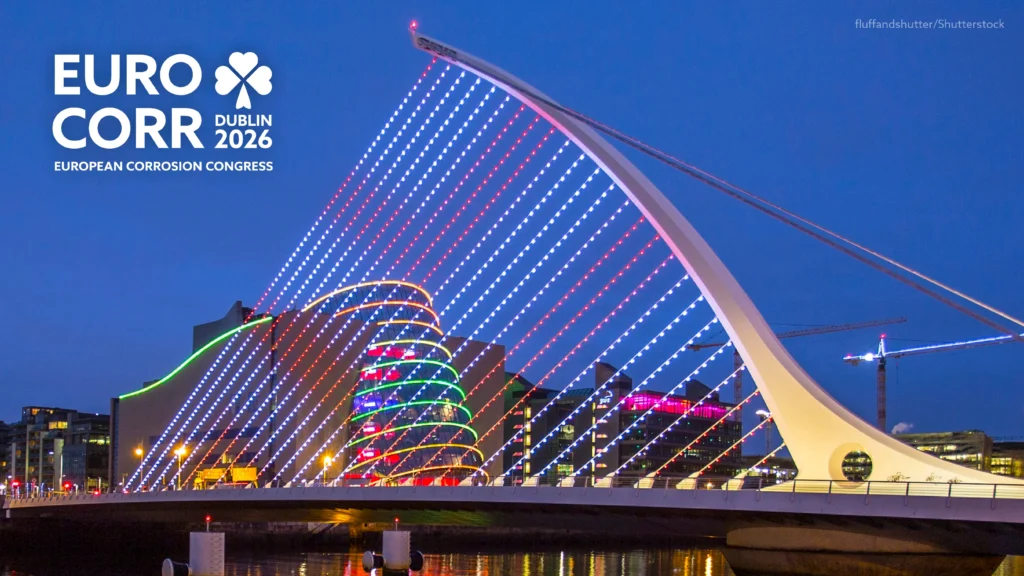
EUROCORR 2026 is in Gareth Hind’s home town of Dublin