


It is not every day you get to work on the kind of structure people plan holidays around, take photos of and point to from across the park. Roller coasters are big, bold, iconic and a little intimidating up close – which is exactly what makes them such a cool canvas, says Melissa Bamford, Director of Marketing at the USA’s Baynum Solutions.
Roller coaster painting is full of details most people would never think about. It is not just picking a colour and covering steel. A roller coaster is a moving, working ride system, and that makes the job a lot more specialised than it looks from the ground.
There are areas you paint, areas you protect, areas you test and sometimes areas you intentionally leave alone. Every decision must account for the ride itself, the coating system, the park environment and the people who will be riding underneath it when the season starts.
The no-paint zone
One of the most interesting details in roller coaster painting is knowing where not to paint.
On many steel roller coasters, there is a visible worn area on the running rails where the road wheels ride. That wear path shows exactly where the train contacts the rail.
That area is not just part of the paint job; it is part of how the ride operates. Because paint on the running surface can affect friction and ride performance, crews are often directed to stay off that wear path. In many cases, that means holding the coating back approximately 1/4 inch (6mm) from the visible line.
There are exceptions. On some roller coasters, or in some specific situations, the owner or manufacturer may request that the rail be painted fully if it does not create the same operational concern. But either way, it is not random. The decision is intentional, and it is one of those small details that makes coaster painting different from painting a normal steel structure.
One giant ride – a roller at a time
A lot of roller coaster painting is done by brush and roller. From the ground, it seems as if something that large would obviously be sprayed. But in a park environment, spraying can create major overspray concerns.
Roller coasters are surrounded by buildings, queue lines, ride vehicles, signs, landscaping, pathways, other attractions, water features, lighting, guest areas and finished surfaces.
And with the specialised industrial coatings used on steel structures, overspray is not just a little mist that disappears. Many of these coating systems are urethanes or similar high-performance coatings, and those particles can travel much further than people expect if wind and conditions are not carefully controlled.
Brush-and-roller lets crew work around running rails, hardware, catwalks, brake areas, station components, platforms, transitions and sensitive surroundings without sending coating where it absolutely does not belong.
It is slower – it is more physical – it takes patience. But there is something amazing about watching a massive coaster come back to life, one rolled section at a time.
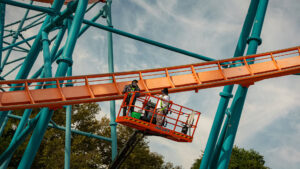
A lot of roller-coaster painting is done by brush and roller
Old paint gets a vote
A roller coaster repaint is not as simple as picking a new colour and getting to work. The coating that is already on the ride matters. What was used before can determine what can be applied next, how the surface needs to be prepared and whether the new coating system will bond properly. Crews also must consider the ride manufacturer’s requirements, the environment, exposure and the coating manufacturer’s recommendations.
Even the colour changes matter. Not every colour covers the same way. A dramatic colour change may require additional coats – and on a roller coaster, one more coat does not mean touching up a wall; it means touching up the whole structure again.
That is where testing and paint manufacturer support can play a big role. Pull tests, coating evaluations and technical support help determine what system should be used. Paint OEMs will often help write the specification that applicators follow, so the project starts with the right plan instead of guesswork.
The view is great and the sway is real
One of the wildest parts of the job is that when you are up there painting, you can actually feel the roller coaster move. Not in a dramatic, something-is-wrong way, but in a roller coasters-are-built-to-move way. From the ground, that idea feels technical. From the lift, basket or tie-off point, it feels very real.
That is the part people do not think about when they see a freshly-painted coaster from the ground. The work is not happening on a flat wall or a quiet building. It is happening in the air, on a ride structure, with a view most people will never get.
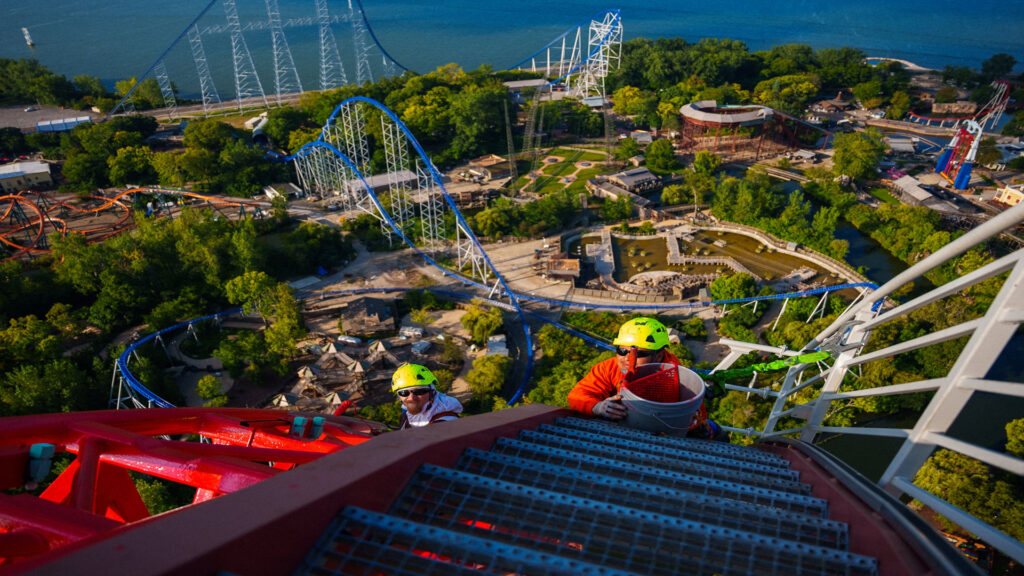
The view is great and the sway is real
Where fading meets protection: Restoring an icon in the Smokies
Dollywood theme park in Tennessee doesn’t shout for attention: it’s layered into the landscape. Nestled in the foothills of the Smoky Mountains, its rides don’t just sit on the terrain; they disappear into it. That’s exactly what made the restoration of the Tennessee Tornado roller coaster such a unique coatings challenge, and ultimately, such a rewarding one.
Some projects start with a bid, but this one started with a climb. In 2013, Baynum’s team conducted an initial walkthrough of the Tennessee Tornado, bringing a NACE Level 2 Coatings Inspector to evaluate the original factory-applied system. Test patches were applied directly to the structure – high above the terrain – validating adhesion, compatibility and long-term performance potential.
Then the story paused. The ride kept running and the mountain kept growing.
Over the years, as Dollywood continued to thoughtfully invest across the park, the Tennessee Tornado project remained part of the broader conversation until the right window arrived in 2024. When the project was ultimately awarded, the groundwork had already been laid, technically and strategically.
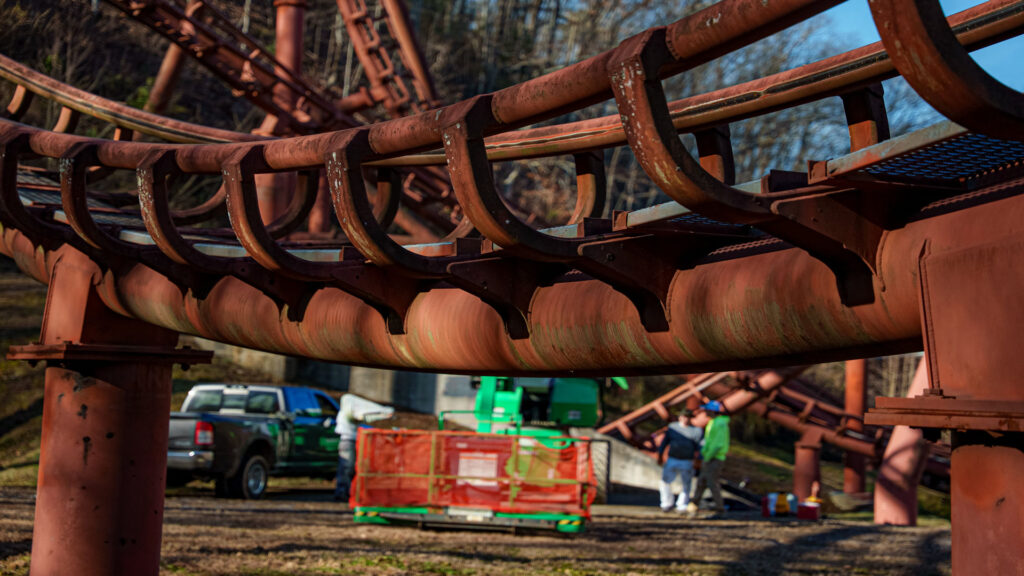
The Tennessee Tornado before restoration
When fading works – until it doesn’t
There’s a nuance here that makes this project different. Over time, the original finish naturally faded – creating a weathered, rust-toned appearance that blended seamlessly into the Smoky Mountain backdrop. It wasn’t designed that way, but it worked. The roller coaster ride settled into its environment in a way that felt authentic to the park’s setting.
But aesthetics does not drive coatings decisions: protection does. At a certain point, the equation shifts – from ‘it works visually’ to ‘it must perform structurally’. That’s when Dollywood made the call.
Access defines everything
The Tennessee Tornado was installed in 1999 – long before the surrounding landscape matured and the park expanded around it. Today, access is the issue: steep terrain, dense growth, limited staging areas and minimal direct approach to large portions of the structure.
To execute the project, Baynum deployed:
- 135ft (41m) and 85ft (26m) boom lifts for primary access
- Specialised spider basket systems for the lift hill
- Multi-position setups to reach over 2,700ft (820m) of track, rising to 163ft (50m).
This is where Baynum’s crews operate at their best: in environments where conventional access simply doesn’t work.
Precision over speed
Unlike many industrial applications, these roller coaster rides are not spray-coated; they are brush and roll only. Because in a guest environment, especially one embedded in terrain like this, coatings can’t travel – containment isn’t optional.
Every square foot of structural steel is coated manually, ensuring:
- Controlled application
- Proper film build
- Zero unintended impact to surrounding areas.
It’s slower – more deliberate – and exactly what the project demands.
System and surface preparation
The coatings system was designed to halt corrosion, stabilise existing substrates and deliver long-term durability, all while maintaining the existing colour profile.
Surface Preparation Standards:
- SSPC-SP1: High-pressure cleaning up to 5,000 psi with biodegradable degreasers
- SSPC-SP2: Hand-tool cleaning (scraping, sanding, wire brushing)
- SSPC-SP3: Power-tool cleaning (grinders, dual-action sanders, wire wheels)
Coating System:
- Rust conversion
- Primer: Sherwin-Williams Macropoxy 646
- Finish: Sherwin-Williams Sher-Loxane 800 Semi-Gloss
The project was executed in two phases:
- Guest-visible sections along the midway
- Remaining track and lift hill tucked deep within the terrain.
A classic, renewed
What began as an evaluation years earlier ultimately became a full restoration of one of Dollywood’s most recognisable attractions.
For Baynum, it was the kind of project that defines the work: technical planning, difficult access, precise execution and respect for the ride’s original character. For Dollywood, it meant extending the life of a modern classic. “Baynum has been a great partner in helping us maintain and conserve our more classic attractions,” said Barry Stiltner, Director of Maintenance. “The Tennessee Tornado, for example, is the last Arrow coaster, and thanks to Baynum, it looks better than it did when we opened it in 1999.”
Flat rides, fully reimagined
While the Tennessee Tornado tells a story of scale and access, Dollywood’s Shooting Star and Sky Rider attractions highlight precision, theming and guest-facing detail.
Shooting Star: A thematic revival
This Zamperla junior drop tower is designed for families, and its visual presence matters just as much as its operation.
The goal wasn’t just to repaint; it was to restore and elevate the ride’s original theme.
- Full structural refresh with red, white and blue colour scheme
- Gradient detailing reintroduced in upper sections
- Gondola restoration (FRP), including:
- Complete sanding and surface preparation
- Spot repairs to damaged fibreglass
- High-finish repaint system for durability and appearance.
Executed using high-detail spray techniques, this project leaned into Baynum’s thematic finishing capabilities: combining coatings performance with visual accuracy.
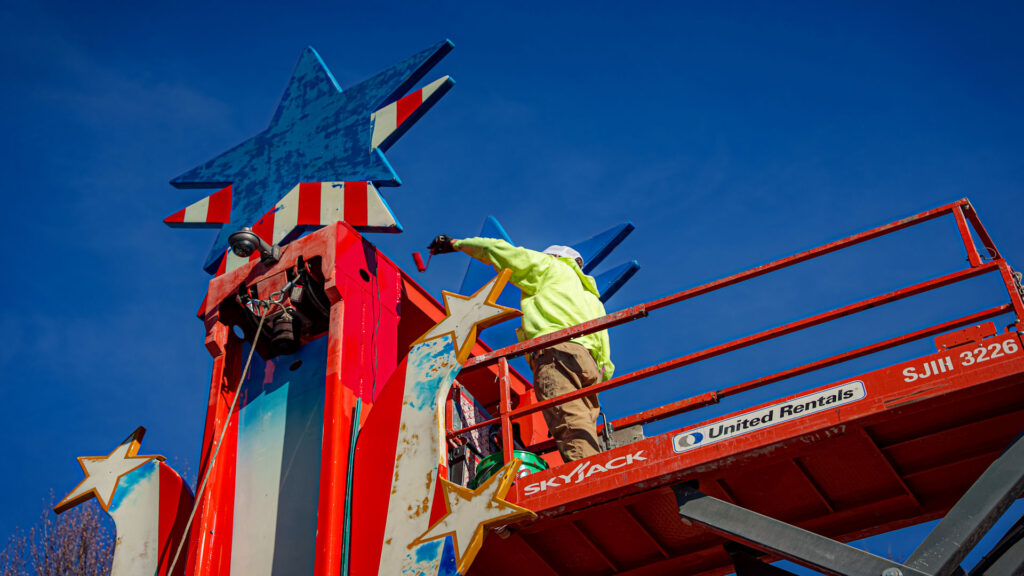
Repainting the details on the Shooting Star
Sky Rider: Precision and consistency at height
A Chance Rides Aviator attraction, Sky Rider lifts guests 70ft (21.3m) into the air, putting every detail on display.
Scope included:
- Structural steel coating system (epoxy + polysiloxane)
- Replacement and stencilling of star elements
- Full treatment of sweeps, mast and ride vehicle hardware.
Coating System
- Primer: PPG Amerlock 2 Epoxy
- Finish: PPG PSX 700 Polysiloxane.
The result is a clean, consistent finish designed to withstand environmental exposure while maintaining visual clarity across all ride elements.
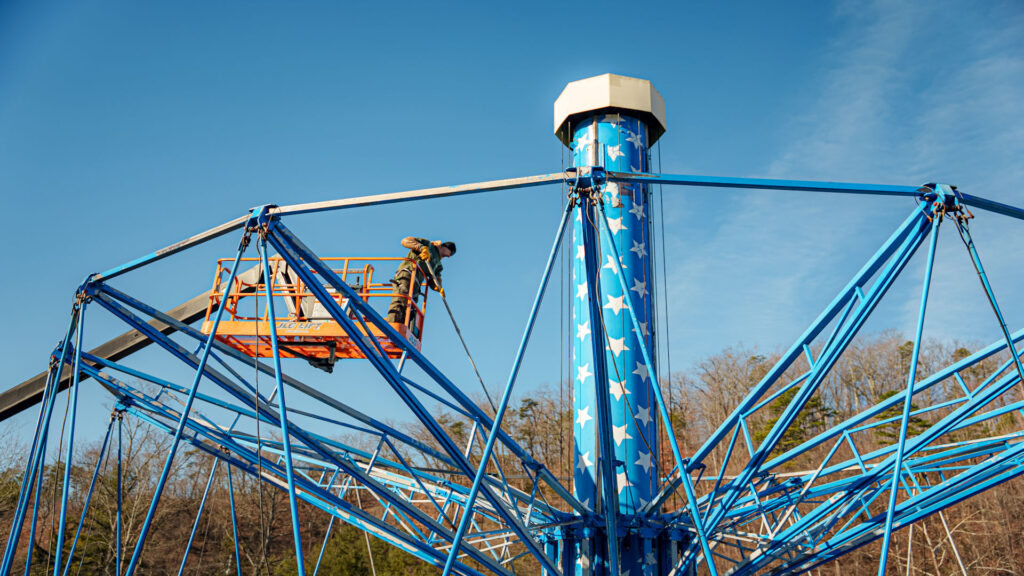
Washing down the Sky Rider prior to painting
Working against the season
This work happens in the off-season, when conditions are far from ideal. Crews operate through:
- Fluctuating temperatures
- Moisture variability
- Tight, non-negotiable timelines.
Baynum adapts with specialised materials and adjusted application methods that allow coatings to perform even in colder conditions.
Safety at every elevation
Working at heights exceeding 150ft (46m) across irregular terrain requires more than standard safety protocols. Crews operate with:
- Full fall protection systems
- Engineered access solutions
- Continuous hazard assessment across changing elevations.
In this environment, safety is constant, not conditional.
More than a coating project
What makes projects like these stand out isn’t just the scale or the technical execution; it is the balance. Preserving the character of beloved attractions, protecting critical assets and ensuring the guest experience feels as timeless as the memories attached to it. At parks like Dollywood, the best off-season work is often the kind guests never notice – they simply enjoy the ride.
Read more like this in the latest issue of Protective Coatings Expert