



Floating offshore wind is entering a new phase of commercial development. Floater designs are continually being refined to meet the needs of deeper waters and greater energy demands. The options for offshore infrastructure assets are rapidly expanding; even data centres could one day be co-located in floating offshore wind sites with platforms like Aikido Technologies’ modular prefabs, says Chris Magel, PPG Oil and Gas Segment Manager, Europe, Middle East and Africa, Protective Coatings.
With the development of new floating offshore wind technologies, protective coating systems must also adapt to a new set of challenges. Floating wind platforms are too large to be transported overland and therefore spend a great deal of time in the water during staging and assembly. They require specific port resources and water depths, which result in global sourcing practices and long transport distances for some components. During operation, floating wind towers must withstand continuous wave action, high winds, vibrations and seawater immersion over design lives of 30 years or more.
These structures occupy a hybrid space between vessel and wind tower, demanding a combination of marine and energy-grade coatings to prevent corrosion and extend asset service life. For floating wind towers, high-performance protective systems need to reduce the attachment of marine organisms during transport, protect ballast tanks from pitting and cracking and resist impact damage from debris and other vessels.
Wind towers with marine components
Compared with fixed-bottom offshore wind towers, floating offshore wind towers have a unique set of requirements. Floaters borrow aspects from marine engineering designs to maintain stability in deep waters instead of relying on monopile or jacket foundations built into the seabed.
There are four main types of platform design in use today, although many other variations have been proposed. Semi-submersible platforms and spar buoys are the most common to date.
- Semi-submersible structures use multiple ballasted columns
- Spar buoy platforms have a large cylindrical ballast tank that extends deep below the water
- Tension leg platforms rely on taut mooring lines anchored to the seabed to limit platform movement
- Barge designs use buoyancy from a broad, shallow floating platform to support the turbine.
For maximum power generation, the industry is moving toward larger turbines. In China, the 16MW Three Gorges Pilot turbine has a rotor diameter of over 800ft (250m). Supersized components increase manufacturing, transport and installation complexity and place greater demands on every aspect of the turbine’s sourcing and construction. These floating offshore wind structures also endure some of the most aggressive environmental conditions in the world, including extreme temperature fluctuations and high wind speeds and wave heights from storms.
Why asset protection strategies must adapt
As floating offshore wind projects seek funding, the levelized cost of electricity (LCOE) is an important metric used to evaluate site and design decisions. Lowering the LCOE can help make a proposal more competitive. Material selection, and protective coatings in particular, play a direct role in calculating LCOE and influencing asset service life.
Highly durable coatings that can maintain protection in the demanding conditions of offshore wind farms can help protect structural integrity and support longer turbine service life expectations. Extending the service life expectation of a turbine helps lower its LCOE, but it also has the potential to increase operation and maintenance costs if the structure requires frequent maintenance.
Repairing damaged coatings in offshore environments is much more complex and costly than performing maintenance in a fabrication yard. Crews must be specially trained to perform work on floating offshore wind structures and properly carry out coating application procedures.
Surface preparation often requires power tools to remove corrosion and deteriorated coating before the new coating can be applied. Rinses between coating layers remove salts that could otherwise contribute to osmotic blistering and premature coating failure.
Undetected coating failures are also more likely to happen in remote floating offshore wind installations, which could jeopardise the operation and power-generating ability of the entire turbine. Owners and developers need corrosion protection systems that minimise maintenance requirements and simplify repair procedures. Coatings that combine long-term durability with efficient application can help reduce total lifecycle costs.
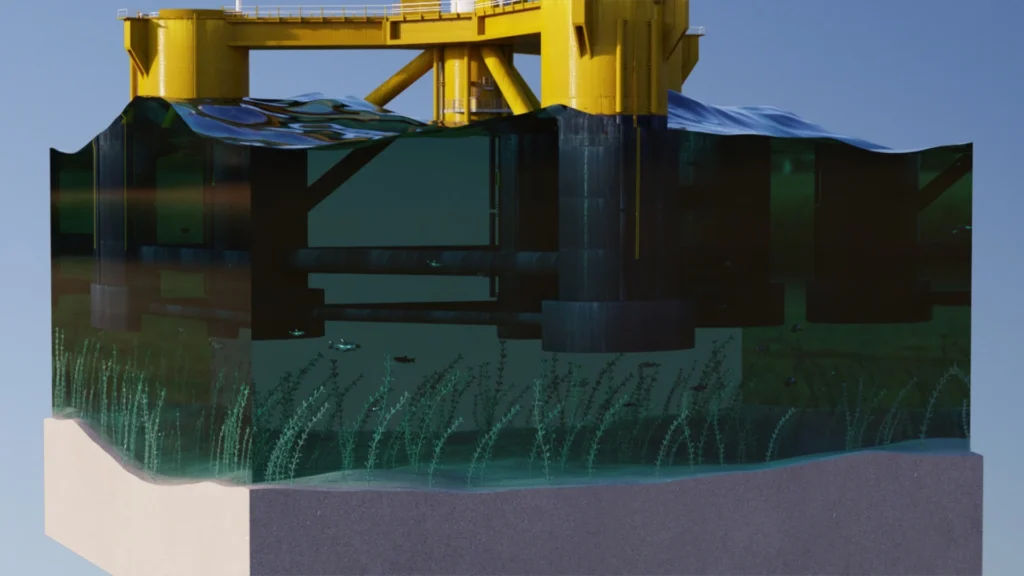
The splash zone is the most corrosive area for floating offshore wind towers
Reducing environmental impact
Beyond cost reductions, there is another layer to coating selection for floating turbines. In the renewable energy sector, projects can be evaluated based on environmental metrics such as reducing carbon emissions or protecting biodiversity. While sustainable production practices are not currently standardised, regulatory frameworks and guidelines are emerging, and many organisations have set voluntary goals to reach net-zero carbon emissions.
Some governments require developers to submit an Environmental Impact Assessment (EIA), which is informed by the EU’s EIA Directive. Environmental product declarations (EPDs and lifecycle assessments ̶ LCAs) are also increasingly used to provide environmental information for materials and technologies. LCA methodologies are addressed in ISO 14040 and ISO 14044, while the availability of EPDs and LCAs varies by specific product and technology.
According to the World Forum Offshore Wind (WFO), the fabrication stage is responsible for the highest amount of carbon emissions in the offshore wind value chain, making material innovation a key part of improving environmental performance. Within the coatings industry, these priorities are encouraging the development of formulations designed to reduce VOC emissions and avoid certain substances of concern. Some formulations can also be applied without the addition of thinners, which may help reduce VOC emissions associated with application, as well as the shipping and packaging, associated with thinners.
The latest innovations in protective coating technologies can help developers meet performance requirements while supporting more sustainable solutions for floating offshore wind towers.
Fouling prevention during transport
Another emissions-intensive process is the transport of wind tower blades, nacelles, tanks and platforms to the wind farm site. Biofouling from marine organisms directly affects fuel consumption during transport. Accumulated clusters of molluscs or barnacles increase surface roughness and hydrodynamic drag during tow-out operations. Research estimates that biofouling can significantly add to the mass of floaters and mooring lines, with some models indicating an increase of up to seven per cent on the platform alone.
In marine vessels, drag caused by biofouling has been studied extensively, and the highest increases in drag are observed on vessels that operate at lower speeds. Slower vessels are more susceptible to the growth of biofouling, meaning that large floating wind tower components in wet storage or being towed out to sea are particularly vulnerable to the effects of marine fouling.
Marine organisms can cause damage to coating systems, leaving steel substrates unprotected. Their adhesion can also result in the spread of invasive aquatic species when wind tower components are manufactured in one location and transported to another region.
These challenges make antifouling coatings, which have a long history of use on commercial vessels, a valuable addition to floating offshore wind protection strategies. By reducing the attachment of marine organisms, appropriate antifouling systems can help limit increases in surface roughness and hydrodynamic drag during transport. Reducing biofouling may also help lower the risk of transporting non-native organisms between regions.
Corrosion protection in ballast tanks
Ballast tanks are another critical area where floating offshore wind platforms benefit from coating technologies developed for the marine industry. These internal compartments provide the ballast needed to maintain platform stability, and are subjected to continuous or intermittent seawater exposure. Ballast tanks are also very difficult to inspect and maintain. Corrosion that occurs at weld seams can lead to leaks, which could compromise the structural integrity of the tank.
Heavy-duty epoxy linings provide resistance to seawater immersion while maintaining the flexibility needed to accommodate the thermal cycling and variable loads found in floating structures. Coating systems that meet the International Maritime Organization’s Performance Standard for Protective Coatings (IMO PSPC) for seawater ballast tanks are widely used as a benchmark for long-term corrosion protection in harsh marine exposure conditions.
Epoxy evolution
At the waterline, the splash zone is the most corrosive area for floating offshore wind towers. Floating debris, ice, and contact from maintenance vessels or mooring operations can cause impact damage. Continuous motion caused by wind and waves generate flexural stresses and pressures on fairlead tensions. Protective coatings must be flexible enough to withstand these movements without cracking or losing adhesion.
High-build epoxy coatings have been used for decades in marine vessels and offshore oil and gas structures. Epoxy chemistry provides the adhesion and barrier properties needed to help protect wind tower structures from demanding environmental exposure. As opposed to unsaturated polyester coatings, amine-cured epoxy coatings form a highly crosslinked polymer network with inherently low water permeability, which allows glassflake loading to be optimised for the specific coating chemistry and improves application efficiency.
The next generation of epoxy coatings also includes formulations designed without solvents that release VOCs. These low-VOC epoxy technologies are already gaining approval for corporate specifications and major floating wind tower prototypes scheduled to launch later this year.
Expanding horizons
Floating offshore wind will continue to open new areas for renewable energy development as the availability of new, shallower seabed sites decreases. In order to maximise service life, owners and developers should explore materials and solutions that are designed for the specific demands of deepwater sites by drawing on, and continually improving upon, proven technologies from the marine and offshore energy sectors. The coatings specified during fabrication can contribute to reducing maintenance requirements, environmental impacts and lifecycle costs for these valuable floating structures.
Chris Magel is the PPG Oil and Gas Segment Manager, Europe, Middle East and Africa, Protective Coatings. He has 15+ years of experience in protective coatings for the oil and gas industry.
Read more articles like this in the latest issue of Protective Coatings Expert