



Arend Dorsman, PPG Key Account Manager, Protective and Marine Coatings looks at how a modern makeover of the SS Rotterdam became a case study in coatings innovation.
When people talk about a maritime legacy, they often focus on the past. Consider romantic stories of ocean crossings and bygone eras. But today, preserving historic vessels like the SS Rotterdam proves to be less about nostalgia and more about innovation, collaboration and sustainability.
What once served as the pride of the Holland America Line (christened in 1958 by Queen Juliana of the Netherlands) now functions as a floating hotel, restaurant and event venue moored in Rotterdam’s harbour. This iconic ocean liner needed more than cosmetic upkeep. It required a strategic, technically advanced preservation effort. That effort now stands as a model for how advanced coatings innovation can extend the legacy of maritime heritage into the future.
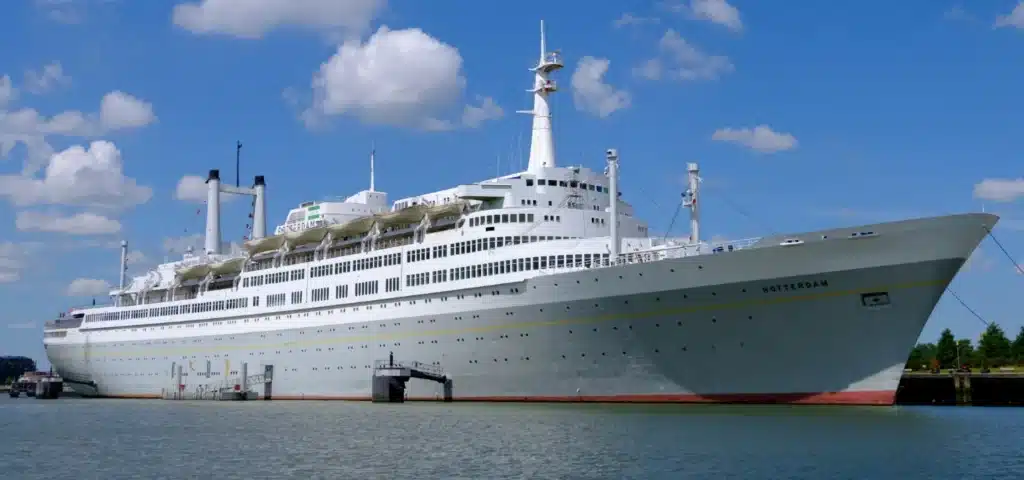
A modern makeover of the SS Rotterdam became a case study in coatings innovation
Static heritage challenges
The SS Rotterdam hasn’t sailed in years, but its battle against the elements hasn’t stopped. As a permanently moored structure, it faces salt-laden air, ultraviolet radiation and corrosion risks whilst simultaneously serving thousands of guests each year. This dual identity (part ship, part building) demands a certain maintenance approach.
Interestingly, its legal classification as a building meant the owners could skip traditional dry docking. That convenience didn’t eliminate the need for high-performance coating solutions. Over time, exposure to sun and sea had faded the vessel’s exterior, and corrosion threatened the ship’s surface integrity.
Enter Smits Vastgoedzorg, the Dutch contractor renowned for restoring architecturally and culturally significant buildings. The firm took on the ambitious challenge of recoating the vessel within six months without disrupting daily operations.
Strategic collaboration, powerful systems
PPG’s Protective and Marine Coatings business partnered with Smits Vastgoedzorg to deliver a solution that worked under intense conditions. Together, the teams specified a coatings system built for durability and aesthetics. They selected:
- PPG SigmaPrime 200: a corrosion-resistant primer formulated for strong adhesion across multiple substrates
- PPG SigmaDur 550: a durable topcoat offering superior UV resistance and long-term colour retention.
Unlike traditional ship maintenance, this project’s operations continued steadily. Hotel guests continued to check in and out, staff remained on duty and the ship’s role as a cultural landmark never paused. This reality demanded a coatings system that could perform under high traffic and logistical constraints. The PPG seastock coatings selected for the project met those expectations, offering ease of application and maintenance flexibility critical for in-service projects.
Scaling new heights
Coating the upper decks and massive funnel of the SS Rotterdam posed access issues. Instead of relying on intrusive scaffolding or mechanical lifts, the team brought in rope-access specialists, a technique often reserved for skyscrapers and industrial towers. This approach enabled work to continue without affecting hotel operations or the guest experience.
The original colour scheme had faded inconsistently after 10-15 years of exposure. Recreating the look wasn’t a simple case of using old colour codes. Instead, PPG’s architectural and marine coatings teams collaborated to match the hues as closely as possible to the vessel’s vintage identity to bridge the gap between old and new without jarring visual contrast.
The results exceeded expectations. The team completed the work ahead of schedule and also delivered the restored ship in time for Smits Vastgoedzorg’s 100th anniversary celebration, hosted aboard the freshly-coated SS Rotterdam.
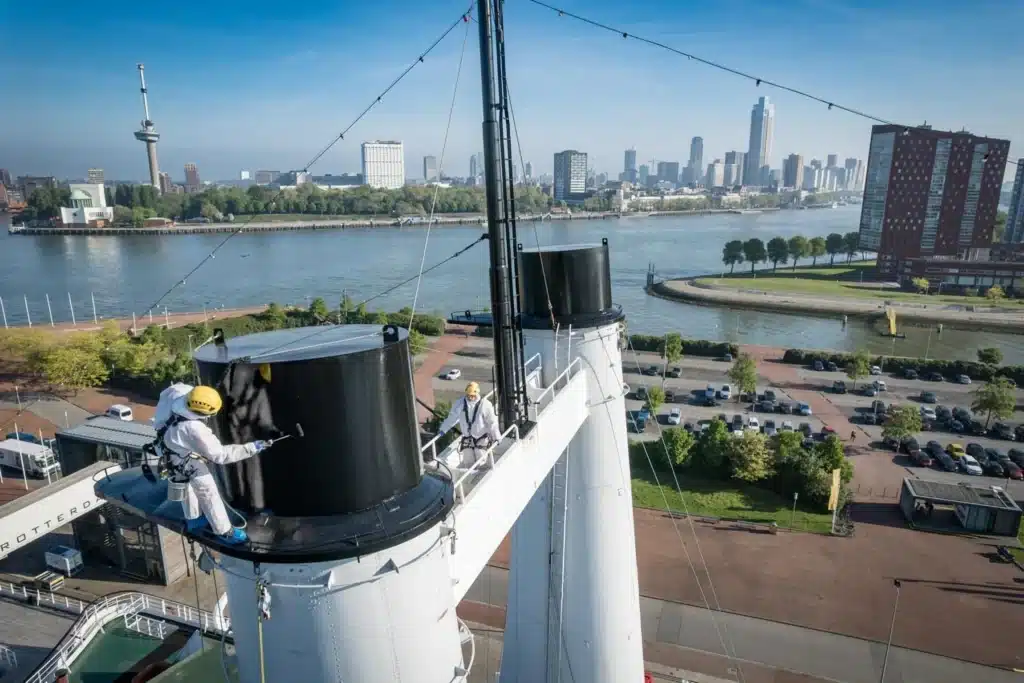
Coating the upper decks and massive funnel of the SS Rotterdam posed access issues
Making sustainability tangible
While the visual transformation is clear to see, the sustainability advantage runs deeper. The longer-lasting coatings reduce the frequency of maintenance cycles, minimising labour and materials.
One example stands out: a steel deck on the ship previously coated in dark paint absorbed solar heat, increasing indoor temperatures and energy usage. Repainting it with a light, reflective white topcoat immediately reduced internal heat buildup, cutting cooling demands and improving comfort for hotel guests. That’s how coatings – often invisible in daily life – can directly support energy efficiency.
Coatings used in this project feature low volatile organic compounds (VOC) formulations and comply with modern regulations. These advancements support both regulatory compliance and corporate sustainability goals, which are critical considerations in hospitality, infrastructure and public-sector projects today.
A blueprint for adaptive reuse
Around the world, architects and developers look for ways to breathe new life into decommissioned ships. Some convert them into student housing. Others into floating offices, museums or hospitality centres. As one 2025 report puts it, “the adaptive reuse of cultural heritage sites represents a strategic approach to sustainable development, aligning architectural conservation with economic and environmental resilience.”
In each case, long-term durability, guest safety and regulatory compliance take centre stage, and advanced marine coatings can play a significant role.
The SS Rotterdam project delivers a clear playbook:
- Use durable coatings that protect and enhance visual appeal
- Collaborate across disciplines early to streamline logistics and avoid surprises
- Embrace modern access techniques to minimise disruption during application
- Align restoration with sustainability goals from material selection to operational energy use.
It’s a message that resonates well beyond the Port of Rotterdam. As more cities face the challenge of conserving maritime heritage, they’ll need trusted coatings partners that offer technical rigour and cultural sensitivity in equal measure.
In conclusion, the SS Rotterdam stands as a physical reminder that the maritime past still holds value. With the right coatings and the right partners, these giants of another era can thrive. PPG and Smits Vastgoedzorg have preserved a city’s icon, demonstrating that technical innovation, thoughtful collaboration and environmental awareness can coexist in a single project.
Arend Dorsman is a PPG Key Account Manager, Protective and Marine Coatings, with 20 years of experience in advanced coatings
Read more articles like this in the latest issue of Protective Coatings Expert