




The preservation and restoration team look back on the past 50 years of John Canning & Co, restoring painting finishes in America’s historic landmark spaces, including how paints, coatings and the technology used have also changed during that time.
For 50 years, John Canning & Co has helped preserve and restore some of America’s most significant historic interiors. From state capitols, courthouses, entertainment venues and theatres to churches, museums, universities and other historic landmarks, Canning’s work has helped preserve the architectural finishes and decorative details that define the character and identity of these historic spaces.
Over the past five decades, the preservation industry has changed considerably. Improved conservation materials, advanced analytical tools and evolving technologies have broadened what is possible in the restoration of historic buildings. At the same time, many of the traditional materials and techniques used by generations of craftspeople remain essential to achieving historically appropriate and compatible results.
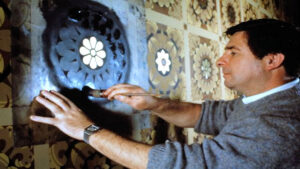
The founder, John Canning
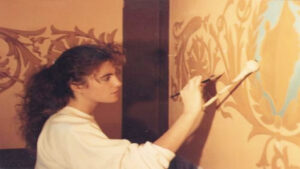
Director of Studio Design Jacqueline Canning-Riccio
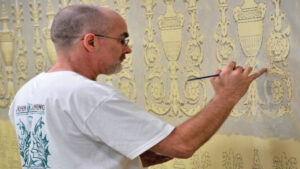
Craftsperson Michael Deluca
Canning prides itself on using traditional materials and techniques. Whilst technology has transformed how we investigate, document and preserve historic finishes, the fundamental principles of preservation remain the same: understand the original material, respect the history of the building and make informed decisions that support its long-term preservation.
The evolution of paints and coatings
The paints and finishes found in America’s historic buildings reflect the materials, technologies and artistic practices of their time. Colour was supplied by pigments, which were combined with binders that held the pigment particles together and secured them to the substrate. Water, drying oils, natural resins, waxes and other media were used, often with additional fillers, driers and modifiers to produce finishes with distinct appearances, working properties and long-term performance.
Traditional coatings commonly included limewash, distemper, casein paint, tempera and oil-based paints. These materials were often mixed or modified by craftspeople to meet the needs of a particular project. Their appearance could vary based on the pigments used, the preparation of the surface, the application method and the surrounding environment. During the late 19th and 20th centuries commercially-produced paints became more widely available, while new pigments, binders, resins and synthetic materials expanded the range of colours and finishes that could be achieved. As the twentieth century progressed, acrylic and latex paints became increasingly common. Modern coatings offered convenience, consistency, durability and faster application. They also made it easier to produce a wide range of colours and sheens on a large scale.
These developments expanded the range of available coatings and transformed painting practice, but they also introduced important considerations for preservation professionals. Modern coating systems may differ substantially from historic materials in composition, ageing behaviour and interaction with building fabric. A product that performs well on contemporary construction can be unsuitable or potentially damaging when applied to historic plaster, masonry, woodwork or surviving decorative finishes. For this reason, preservation work involves far more than matching a historic colour or sheen. Coating selection must account for properties such as permeability, flexibility, adhesion, sheen, reversibility and compatibility with the substrate and any existing finish layers.
Depending on the project and what our investigations uncover, we adopt these preservation advances while also sticking to more tradition-based paints. By tradition-based paints we are referring to the historic formulations or colour palettes designed for the building’s period, which can include using limewash, linseed oil paint, mineral pigments, sticking with architectural colour palettes and so on.
When evidence indicates that an original decorative scheme was created using a traditional material, recreating or repairing that finish may require the use of historically appropriate paints, pigments, binders and application techniques. In these cases, tradition-based materials can help achieve the appearance, texture, depth and surface quality of the original work.
Using traditional materials is not simply about reproducing the past. It can also be important for compatibility. When appropriate, Canning’s artisans use traditional materials and time-tested techniques to preserve the visual and material character of historic spaces. These methods are supported by decades of hands-on experience and an understanding of how historic finishes were originally designed, prepared and applied.
Preserving traditional craftsmanship
Canning has had the opportunity to work on numerous projects that demonstrate the importance of traditional materials and techniques. One notable example is the Old Senate Chamber in the Maryland State House, where Canning restored eighteenth-century plaster walls and ornamentation using original methods and materials of the period.
True and faithful to the restoration process, we mixed traditional old-fashioned soft distemper and linseed oil paint to use. Distemper is the ideal paint for traditional lime plaster. It dries to a very desirable soft matte finish and, since it is high in permeability, allows the plaster to breathe and thoroughly cure. We applied the paint with six-inch (150mm)-wide brushes. The soft distemper formulation included pigment; a binder such as animal-skin or bone glue or casein; preservatives including carbolic acid and borax; alum as a hardener and glycerine, soap or sugar as a retarder.
This project demonstrates how traditional materials can remain highly relevant within modern preservation practice. Rather than replacing historic techniques with contemporary products, Canning was able to recreate the original material characteristics and application methods to achieve a result appropriate to the building’s historic fabric.
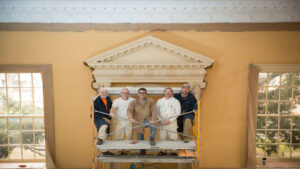
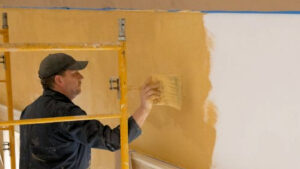
Examples of Canning painting the walls using 150mm-wide brushes at the Old Senate Chamber
Revealing hidden histories
Another notable project was the Philadelphia Academy of Music, where Canning worked to expose and define the building’s original decorative design scheme. The investigation involved paint analysis of up to 16 layers in some areas, along with aggressive exposure methods used to reveal faint, ghosted patterns that remained beneath subsequent layers of paint.
The ghost patterns corresponded with original designs visible in an archival photograph believed to date from the building’s completion in 1857. By comparing the physical evidence uncovered through paint exposure with historic documentation, Canning was able to better understand the original decorative scheme and use those findings to guide the restoration work.
Continue reading this article in the latest issue of Protective Coatings Expert magazine
.